Blog

1964 Gibson 175 and thoughts on quality, build, etc. 

I wanted to give a short write-up on my 1964 Gibson 175.

As some of you know, I've had close to 12 175s as well as a couple 165s.

I'd had them from almost every era, 1964, 1968, 1971, 1974, 1989(4), 2005, 2012

As time went on, gibson made the build heavier and heavier in an attempt to save money on warranty repairs. They also briefly flirted with 3pc mahogany and 3pc maple necks to avoid warpage. Tops also got thicker and glues were changed. Originally hide and then PVA. I have heard that the modern 175s used epoxy for the plates but I'm not sure.

In 2012, gibson was "caught" using laminated fingerboards so it's possible the 175 from that era also fell victim.

I haven't played a real '57 and only briefly played a '57 reissue so I can't tell you much about them.

This '64 is remarkable in that there is almost no top sinkage. By contrast, when you get up to the '80s 175s, they almost all have significant top sinkage. One of the first things I do when I look at a 175 is look at how many threads are visible above the base. On the late '80s models, you often see 1/4" to 3/8" of threads visible. On my 64, there is less than 1/8. Of course this can vary based on the hight of the base/bridge itself. I'm talking the standard base and bridge, including tuneamatic.

IMO, the '88/'89 guitars were the last era that had a light enough build that you actually got some acoustic resonance when you played electrically. Sadly, the 88/89 guitars also suffer from extreme top sinkage. I've heard that Gibson flirted with kerfed bracing but I cannot confirm which eras had this.

My 64 has a couple screw holes in the top which apparently were from a bigsby. It also has replaced pickups (patent # pickups). Tuners, tailpiece are also replaced. It weighs slightly more than 6lb compared to the 7.5lb of the 2012 I recently sold.

Earlier ones have a much more resonant vibe to them than the modern ones. Each decade generally brought heavier builds and had different characteristics, progressively worse build quality/younger woods and subsceptibility to top sinkage, warping, etc.

Will write more later and accompany with a sound demo.

Does western theory or jazz theory provide rules for improvisation? 

Preface, I have taught jazz theory, improvisation and jazz guitar at the university level. I'm the author of the Sheets of Sound for Guitar series books. I'm well versed in traditional and jazz theory.
---------------------------
Do you realize that theory, in particular -- western theory, is an after-the-fact analysis of composed music? We tend to think of theory as rules and formulas when it's simply a common language used to describe what someone else has done.

The common western theory taught in universities is based on the Baroque period of music (1600–1750).

And then, when jazz came along, we tried to analyze it in terms of Baroque rules and principles. Along came Bird, Trane, Herbie, Chick and up and up.

AND WE ARE STILL USING BAROQUE terminology to describe jazz. Of course, Barris Harris, Hal Galper, Dave Liebman updated these principles and helped usher in a period of what we now refer to as "Jazz Theory".

Of course, we are still taking after-the-fact analysis and attempting to generate rules and regulations about what is valid based on looking at things backwards.

Reality check -- You don't play by the rules. YOU MAKE THE RUlES. The rules will bend to follow what you played. If it sounds good, it *IS* good.

With all that being said, can you play a b9 against a Maj7 chord? Answer, YES OF COURSE YOU CAN. Try taking a tune like "You stepped out of a dream" and for ever tonic, Try using an altered dominant tonality. Does it work? Yes, does it fit the rule books? Who cares!!!

Let's stop trying to use western theory (baroque or otherwise) to govern what we can or cannot do in jazz.

Rules are like labels, jazz is not Mayonnaise.

I'll post some more articles like this in the future, perhaps taking these concepts forther.

Got my PRS NF-53 yesterday 

I received my PRS NF-53 yesterday. It’s exactly what I was hoping for. A slightly fatter sounding  version of a tele but with better quality. I love the nearfield pickups. They are twangy but yet have a little bit more warmth than tele pickups, completely quiet and hum-canceling.


I’ll be using this on my next album. The only thing I don’t like about it is the spliced neck. Puzzling why a $3k, USA made guitar would need a spliced neck.

And please don’t tell me it’s for stability. I have Gibsons and Ibanez guitars ranging from 65-30 years old and the necks are perfectly stable. This was done for cost-cutting reasons.

Fortunately, I bought it used so I didn’t pay $3k for it but IMO, an instrument in this price range should not have a spliced neck.

Album update - Producer quit in the middle of mixing! 

From the beginning, he and I never saw eye to eye on the sound I was looking for. After the first song went back and forth nearly a dozen times, I told him I didn't think we should continue because he had such a different vision (ear) for what the overall tone and balance should be. He offered to work more closely with me and do interactive sessions to fine tune the mix – which I accepted.

However, we continued to go back and forth about the guitar and bass tone. I was never happy with what he came up with for either. They always sounded brighter and more mid-rangy than my rough mixes. Both the singer (Srbuhi Hovhannisyan) and I spend a lot of time recording our music and we both have gotten to the point where we are recording the sounds we want to hear. Slight tweaks are always expected during mixing but changing the fundamental tone of our instruments/voice is not expected.

In late May, he sent me the initial mix for my song,  Mirage of Tranquility and said that he did not touch the guitar tone, per my request. I listened to it and it sounded brighter than my rough mix so I compared the two and his version was 20% brighter on the vocals and the guitar. I asked him about it and he told me that it's probably the sonic maximizer he uses on the master track. I told him to please remove that and that this is a simple, small group, jazz recording, not a pop release and that it doesn't need a sheen on top. Evidentally that offended him and he sent me a response saying that essentially, he was recusing himself from working on the rest of the record. I inquired about the status of the deposit I gave him for this song and the mix meeting we have scheduled, and he indicated that the meeting is canceled and he won't be giving a refund. Sadly, the first pass  track he sent me (not stems) is unusable. 

I'm just eating the loss and using it as incentive to kick my butt and learn how to do the final mixing, mastering.

My process for my new album, When I Breathe  

For years I wanted to put out an album but with such fabulous guitarists out there such as Dan Wilson, Cecil Alexander, Mike Moreno, Jonathan Kreisberg, Adam Rogers, etc., I would often ask myself what the point was. I didn't want to be one of those guys who printed 200 cds and put 275 in the attic after giving them to friends and relatives.

And my career has slowed down and I'm not gigging like I used to so i doubted I'd be successful setting up a merch table at the few gigs I do these days.

However, I had done a steady gig for 8 months playing a lot of my original songs and I thought it would be a shame if -- after I'm gone -- my songs were relegated to a book on someone's shelf that would get tossed out during a move.

And I wanted to dedicate an album to my muse -- my wife -- Sandra Lester. So I decided to write lyrics expressing my love for her and to try to get a band together to try to record my music. My tunes are very difficult and I had a difficult time finding a singer who could sing my melodies and then I happened to hear this singer from Armenia -- Srbuhi Hovhannisyan -- who had incredible range, musicianship and the voice of an angel. I approached her and asked her if she'd be interested in remotely collaborating on music. I didn't have any lyrics at the time and she offered to help. However, I've written love poetry to Sandra for years and I felt like I could take my words and transform them into lyrics.

EXTREMELY NAIVE!

It was a lot harder than that I thought it would be. But one tune at a time, I wrote lyrics, recorded a rough draft of the song using Reaper, with guitar melody, rhythm, ez drummer and myself playing bass.

I would then send her the recording along with sheet music and she'd record the melody and send it back as a .wav file which I'd incorporate into my project, eventually adding real drums and bass. Inspired by Roy Hargrove's Moment to Moment (roy hargrove with strings), i decided to write some string arrangements for the first couple of tunes. I tried several times to hire a real string arranger but found that many didn't have the harmonic knowledge to navigate the chord changes of my music, so I learned on the job. I got better as the project progressed. At one point, I spent a couple hundred dollars (down payment) on a string arrangement for one of my ballads and it was a diaster because the arranger didn't understand slash chords and advanced harmony. So I ended up using my own arrangement.

I bought a bunch of plugins from orchestral tools and spitfire and used those for the strings. That turned out to be its own black hole because the spitfire strings had a HUGE lag time, sometimes as much as 250ms and they were inconsistent, i.e. I couldn't just apply single negative offset to the track. They were off by varying amounts depending on the register of the instrument. So I mostly used orchestral tools strings, some of their soul choral voices and a little bit of garritan strings.

We did not record this live in a studio. It was a challenge to get a live feel to it and so when we would track the bass parts, the bassist would react to my solo as if we were playing in the room. I would then send the tracks to the drummer and he'd do the same thing. Sometimes, the drums would track before the bassist.

I realize that this is not the correct way to record a jazz album but I wasn't trying to record a hard-core jazz album as i mentioned earlier. I consider this kind of a pop album coming from a jazz musician's perspective. I wanted to record my originals and highlight the song-writing, arranging and make something that was listenable to more than just a hardcore jazz audience while -- at the same time -- reflecting the love and respect for jazz that I have put some much of time time and life into over the past 50+ years as a jazz guitarist.

It's also been a bit of a learning experience having the songs mixed because the produce has a different vision of vocal sound and guitar sound than I do and we've gone round and round about this. Sadly, my knowledge and experience mixing drums is very limited, otherwise I'd have done the whole mix myself.

[UPDATE] Producer is out! 

https://jackzucker.com/blogs/thoughts-of-the-day-1-22-2024/posts/7578703/album-update-producer-quit-in-the-middle-of-mixing

I used 4 guitars on the project. A Holst Jim Hall guitar for most of the tracks, a Gibson 175 for a couple tracks, Ibanez PM120 for one solo and a Heritage eagle for some fills. All the guitars and bass parts were recorded with a Fractal FM3.

Managing the process has been an incredible trip. I've probably spent 8+ hours a day for 3 months working on this. Additionally, coming up with a design for the album cover has been challenging. I'm a photographer and consider myself pretty good at design but I've rarely done anything like making a cover and I'm so close to the project that it has been difficult. I hired a couple people to do cover designs but hated them. It seems that most people doing covers only know how to do modern, rock and hiphop type covers and nothing seemed appropriate for my audience. I struggled with whether to put myself on the cover because, well -- who wants to see an old guy on the cover of an album -- but, at the same time, I thought I should leverage the 15,000 followers I have on my youtube channel. I finally have a design that I like on the album. I'm going to use a painting that Jeff Matz did of me.

I'm finally done with the recording and engineering side and just dealing with getting everything mixed and uploaded to Distrokid. When the album's finished, I'll put it up on bandcamp.

Steve Holst Jim Hall guitar mini review part II 

Steven Holst Jim Hall / D’Aquisto mini review part II

Up Front – I am not an endorser for Holst nor have I received remuneration for this review.

I wanted to give an update after using it on my gig last night.

I can now say conclusively that it’s the best sounding guitar I’ve ever had. 

Here are some of the guitars I’ve used on this long running gig.

  • Gibson Barney Kessel,
  • Heritage Eagle,
  • Gibson 175 (2013 & 1989),
  • Gibson L4CES,
  • Ibanez Benson GB10,
  • Ibanez Metheny PM120,
  • Gibson 335,
  • MJT Strat, (yeah, I know…),
  • Steven Holst – Jim Hall / D’Aquisto

The Holst is just in another league. The sustain is wonderful, the lilt of the note’s attack is just beautiful, and I could get lost in it alone. And there is just some “je ne sais quoi” that makes it incredibly satisfying to play and lends itself to playing in a lot of different styles. Part of it may be the dynamic range. It’s got a wider dynamic range than any Gibson I’ve played in years. I have the action pretty low, so it buzzes a tiny bit if I dig in but even the quality of that buzzing is sweetness to my ear. 

It’s able to reproduce a very wide range of tones based on hard I pick, whether I pick with my thumb or use a cellulose or plastic pick, etc.

It’s the first laminate guitar I’ve ever owned that sounds fantastic for octaves. And it’s interesting because on my heritage eagle, which is a solid spruce top, of course octaves sound good on it because it has that Wes-thing going on. However, the Holst sounds equally good with octaves but does not sound exactly like Wes’. I realized a few days ago that the note separation is fantastic and better than anything else I have, which – along with the dynamic range – allows octaves to just jump out as if they were fired out of a cannon. And likewise, the same with block chords.

I will post more thoughts later along with another demo. I spent about 15 takes yesterday trying to record something but my mind was not clear, so I didn’t get anything I liked. Hopefully today!

All the best,

Jack Zucker

Steve Holst Jim Hall guitar mini review 

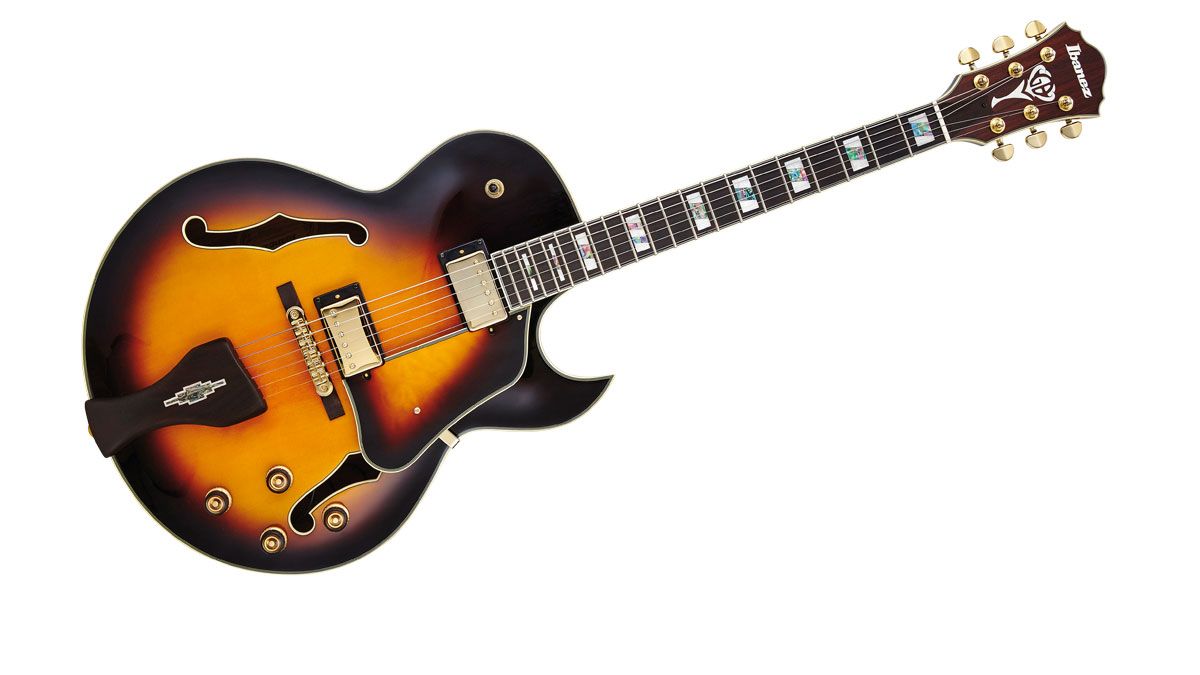
I wanted to write up a small review of this guitar. It’s a 16” laminate archtop, 2pc mahogany neck, ebony fingerboard, ebony bridge, tailpiece, single PAF style humbucker, 24.75” scale. Neck is somewhat of a medium C, a tad less depth than a late ‘90s 175. The 2pc mahogany is welcome as so many 175s end up with truss rods maxed out and washers under the nuts. This neck is very stable and will likely remain so for years to come because of the design. Top and back are custom, 6 ply maple (a bit more about this in a couple paragraphs), sides are solid maple , duncan SD-59 pickup.

It was custom made (2 buyers ago) inspired by the d’aquisto that Jim Hall played for years. (Later, re-made in Japan by Aria as a Sadowsky Jim Hall model).

Like the D’Aquisto and unlike the Sadowsky, this instrument is totally hand-made from the ground up, including custom laminate plates similar in style to what Borys uses. Incidentally, some folks may not know that D’Aquisto used Borys’ plates for his laminate top guitars.

Front and back are laminated plates with 6 alternating grain hard maple plates. This is different than gibson who uses 3 ply maple/poplar/maple with the 2 outer maple layers being really thin and the poplar being thick. The soft/thick poplar is partially what gives gibson archtops that thuddy/nasally/thunky tone. The upper bout of the holst gently flattens out so he can do different cutaway types. The raw plates on the back and sides are identical to start out with.

Construction, attention to detail, and implementation are all flawless. It’s simply the best built guitar I’ve ever owned.

I bought this guitar thinking it would sound like a ‘60s 175. IT DOES NOT. Instead, it sounds like a $50,000 d’aquisto (which is even better). In the ‘70s, Slight sidebar - I met Jimmy D’Aquisto and got to hang out with him, hear his philosophies on “tone woods”, “tap tuning” and the like and play some of his guitars. I’ve owned a reissue d’aquisto jazz line and a Jim Hall and I think the holst has a sweeter and warmer tone. I think it’s hard to beat a hand made instrument and the mahogany neck on the holst vs the maple neck of the aria guitars makes a difference too.

This Holst guitar is the closest I have ever played to a real d’aquisto and it’s about 1/10 the price!

I am using it Wednesday on my steady gig but used it for a rehearsal yesterday and it’s simply an incredible instrument.

It’s currently strung up with Thomastik JS112 strings. 

Unlike a 175, it’s got incredible sustain and has a bright clear top end with just a hint of plywood thunk. It does *NOT* have that middy/dead thunk that dominates the 175 tone, and the slight bump in top end combined with a subjectively “better” neck pickup placement makes for a real sweetness in tone that I couldn’t possibly get with any 175 I’ve ever owned.

It’s super responsive to pick placement too. I find that on the 175, if I pick slightly over the fingerboard, I get a somewhat gnarley tone but on the Holst, it sounds beautifully mellow tone, no matter how far up the fingerboard I pick.

OK, I’m going to stop the mini review for now and go back to playing this guitar but look for some clips and perhaps a video review soon.

Another #guitarcenter (mayfield heights, ohio) horror story from a few years ago 

About 5 years ago, i went into guitar center in mayfield heights ohio and there was a rare respite from the usual $300 instrument line they normally have hanging there.

There was an Ibanez LGB30 which is the more reasonably priced (chinese made) version of the very expensive LGB-300 guitar.

It was used and they wanted about $800 for it which was reasonable for (retail) used.

I played it and it sounded REALLY good. Except that it was a buzz-fest. Sounded like a sitar if you dug in even a little. I asked them if I could get a free fret level and they said I could not but that the repairman was relatively inexpensive. 

So I bought it and left it for the repairman to work on. I figured if I could get a great jazz axe for $900, it would still be a great deal.

A week later, I get a call from the repairman saying that there was no buzzing and he didn't know what I wanted done on it. I was kind of shocked and offered to come in and demonstrate the issue. I was kind of puzzled because it wasn't just one or two frets. The buzzing was all over. I'm guessing the nut was cut way too low or that there was a high fret, very low on the fingerboard.

At any rate, I come in and he plugs it into a little SS marshall with the preamp dimed, and proceeds to play a bunch of chugga-chugga and metal riffs on it at high gain, on the bridge pickup and says, “See, there's no buzzing”.

I asked him for the guitar, adjusted the amp so that the master was all the way up, the preamp was down around 9 O'Clock, put the guitar on the neck pickup and played a few jazz lines and chords.

He replied, “What is that??? I don't even know what that is. WHO PLAYS LIKE THAT???”

I asked him if he was familiar with jazz guitar or clean sounds and he said he was not but that he knew some people played without gain.

NOTE - THIS IS GUITAR CENTER'S REPAIRMAN WE'RE TALKING ABOUT.

He told me, “I would have no idea how to fix something so that playing that stuff sounds good”. I thanked him for his time and immediately took the guitar back to the sales counter and initiated a return.

Ibanez LGB30 review | MusicRadar
  • 1 comment
  • Share

This just happened to me at #guitarcenter mayfield heights, ohio 

This just happened at guitar center in mayfield heights, ohio...

I wanted to buy an alto TS412 powered cab. Web said they had them in stock. The drone there said, we don't carry alto. It's an exclusive brand that you can only buy direct. I told him the website said they had them in stock and he said , "what is it, a guitar cab?". I replied. "no , it's a powered pa cab", and he said, "Raw speaker?". I replied, "look, it doesn't matter what it is. Look it up in your inventory. Unless the site is wrong you have them in stock." He replied, we don't carry them. Finally the manager overheard and said, "we have 5 in stock. They are right over there"...

Then after I paid for it the guy asks me to buy the extended warranty and I said no and he replied, "Why not? You don't care about your gear?". I was ready to punch him. I told him extended warranties were a rip off so he said, "Fine, your loss. Don't come crying to me if it breaks the as soon as you get home. " So I said, "Wait, it comes with a 45 day money back guarantee, doesn't it?" He replies, "Maybe". And I said "look bruh, either it does or it doesn't and I walk". Finally he admits it does.

And then he watched me struggle to carry this big-ass box out the door and didn't offer to help or lend me a cart...